





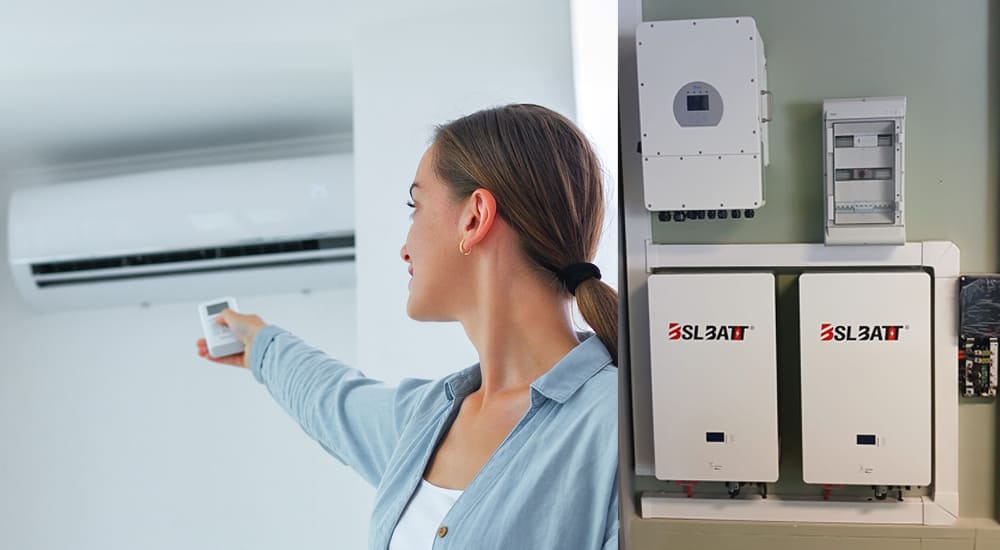
As summer temperatures soar, your air conditioner (AC) becomes less of a luxury and more of a necessity. But what if you're looking to power your AC using a battery storage system, perhaps as part of an off-grid setup, to reduce peak electricity costs, or for backup during power outages? The crucial question on everyone's mind is, "How long can I actually run my AC on batteries?"
The answer, unfortunately, isn't a simple one-size-fits-all number. It depends on a complex interplay of factors related to your specific air conditioner, your battery system, and even your environment.
This comprehensive guide will demystify the process. We'll break down:
- The key factors determining AC runtime on a battery.
- A step-by-step method to calculate AC runtime on your battery.
- Practical examples to illustrate the calculations.
- Considerations for choosing the right battery storage for air conditioning.
Let's dive in and empower you to make informed decisions about your energy independence.
Key Factors Influencing AC Runtime on a Battery Storage System
A. Your Air Conditioner's (AC) Specifications
Power Consumption (Watts or Kilowatts - kW):
This is the most critical factor. The more power your AC unit draws, the faster it will deplete your battery. You can usually find this on the AC's specification label (often listed as "Cooling Capacity Input Power" or similar) or in its manual.
BTU Rating and SEER/EER:
Higher BTU (British Thermal Unit) ACs generally cool larger spaces but consume more power. However, look at the SEER (Seasonal Energy Efficiency Ratio) or EER (Energy Efficiency Ratio) ratings – a higher SEER/EER means the AC is more efficient and uses less electricity for the same amount of cooling.
Variable Speed (Inverter) vs. Fixed Speed ACs:
Inverter ACs are significantly more energy-efficient as they can adjust their cooling output and power draw, consuming much less power once the desired temperature is reached. Fixed-speed ACs run at full power until the thermostat turns them off, then cycle on again, leading to higher average consumption.
Startup (Surge) Current:
AC units, especially older fixed-speed models, draw a much higher current for a brief moment when they start up (compressor kicking in). Your battery system and inverter must be able to handle this surge power.
B. Your Battery Storage System's Characteristics
Battery Capacity (kWh or Ah):
This is the total amount of energy your battery can store, typically measured in kilowatt-hours (kWh). The larger the capacity, the longer it can power your AC. If capacity is listed in Amp-hours (Ah), you'll need to multiply by the battery voltage (V) to get Watt-hours (Wh), then divide by 1000 for kWh (kWh = (Ah * V) / 1000).
Usable Capacity & Depth of Discharge (DoD):
Not all of a battery's rated capacity is usable. The DoD specifies the percentage of the battery's total capacity that can be safely discharged without harming its lifespan. For example, a 10kWh battery with a 90% DoD provides 9kWh of usable energy. BSLBATT LFP (Lithium Iron Phosphate) batteries are known for their high DoD, often 90-100%.
Battery Voltage (V):
Important for system compatibility and calculations if capacity is in Ah.
Battery Health (State of Health - SOH):
An older battery will have a lower SOH and thus a reduced effective capacity compared to a new one.
Battery Chemistry:
Different chemistries (e.g., LFP, NMC) have different discharge characteristics and lifespans. LFP is generally favored for its safety and longevity in deep cycling applications.
C. System and Environmental Factors
Inverter Efficiency:
The inverter converts the DC power from your battery to the AC power your air conditioner uses. This conversion process isn't 100% efficient; some energy is lost as heat. Inverter efficiencies typically range from 85% to 95%. This loss needs to be factored in.
Desired Indoor Temperature vs. Outdoor Temperature:
The greater the temperature difference your AC needs to overcome, the harder it will work and the more power it will consume.
Room Size and Insulation:
A larger or poorly insulated room will require the AC to run longer or at higher power to maintain the desired temperature.
AC Thermostat Settings & Usage Patterns:
Setting the thermostat to a moderate temperature (e.g., 78°F or 25-26°C) and using features like sleep mode can significantly reduce energy consumption. How often the AC compressor cycles on and off also impacts overall draw.
How to Calculate AC Runtime on Your Battery (Step-by-Step)
Now, let's get to the calculations. Here's a practical formula and steps:
-
THE CORE FORMULA:
Runtime (in hours) = (Usable Battery Capacity (kWh)) / (AC Average Power Consumption (kW)
- WHERE:
Usable Battery Capacity (kWh) = Battery Rated Capacity (kWh) * Depth of Discharge (DoD percentage) * Inverter Efficiency (percentage)
AC Average Power Consumption (kW) = AC Power Rating (Watts) / 1000 (Note: This should be the average running wattage, which can be tricky for cycling ACs. For inverter ACs, it's the average power draw at your desired cooling level.)
Step-by-Step Calculation Guide:
1. Determine Your Battery's Usable Capacity:
Find Rated Capacity: Check your battery's specifications (e.g., a BSLBATT B-LFP48-200PW is a 10.24 kWh battery).
Find DOD: Refer to the battery manual (e.g., BSLBATT LFP batteries often have 90% DOD. Let's use 90% or 0.90 for an example).
Find Inverter Efficiency: Check your inverter's specs (e.g., common efficiency is around 90% or 0.90).
Calculate: Usable Capacity = Rated Capacity (kWh) * DOD * Inverter Efficiency
Example: 10.24 kWh * 0.90 *0.90 = 8.29 kWh of usable energy.
2. Determine Your AC's Average Power Consumption:
Find AC Power Rating (Watts): Check the AC unit's label or manual. This might be an "average running watts" or you might need to estimate it if only cooling capacity (BTU) and SEER are given.
Estimating from BTU/SEER (less precise): Watts ≈ BTU / SEER (This is a rough guide for average consumption over time, actual running watts can vary).
Convert to Kilowatts (kW): AC Power (kW) = AC Power (Watts) / 1000
Example: A 1000 Watt AC unit = 1000 / 1000 = 1 kW.
Example for a 5000 BTU AC with SEER 10: Watts ≈ 5000 / 10 = 500 Watts = 0.5 kW. (This is a very rough average; actual running watts when the compressor is on will be higher).
Best Method: Use an energy monitoring plug (like a Kill A Watt meter) to measure your AC's actual power consumption under typical operating conditions. For inverter ACs, measure the average draw after it has reached the set temperature.
3. Calculate Estimated Runtime:
Divide: Runtime (hours) = Usable Battery Capacity (kWh) / AC Average Power Consumption (kW)
Example using previous figures: 8.29 kWh / 1 kW (for the 1000W AC) = 8.29 hours.
Example using 0.5kW AC: 8.29 kWh / 0.5 kW = 16.58 hours.
Important Considerations for Accuracy:
- CYCLING: Non-inverter ACs cycle on and off. The calculation above assumes continuous running. If your AC only runs, say, 50% of the time to maintain temperature, the actual runtime for that cooling period could be longer, but the battery is still only providing power when the AC is on.
- VARIABLE LOAD: For inverter ACs, power consumption varies. Using an average power draw for your typical cooling setting is key.
- OTHER LOADS: If other appliances are running off the same battery system simultaneously, the AC runtime will be reduced.
Practical Examples of AC Runtime on Battery
Let's put this into practice with a couple of scenarios using a hypothetical 10.24 kWh BSLBATT LFP battery with 90% DOD and a 90% efficient inverter (Usable Capacity = 9.216 kWh):
SCENARIO 1: Small Window AC Unit (Fixed Speed)
AC Power: 600 Watts (0.6 kW) when running.
Assumed to run continuously for simplicity (worst-case for runtime).
Runtime: 9.216 kWh / 0.6 kW = 15 hours
SCENARIO 2: Medium Inverter Mini-Split AC Unit
C Power (average after reaching set temp): 400 Watts (0.4 kW).
Runtime: 9.216 kWh / 0.4 kW = 23 hours
SCENARIO 3: Larger Portable AC Unit (Fixed Speed)
AC Power: 1200 Watts (1.2 kW) when running.
Runtime: 9.216 kWh / 1.2 kW = 7.68 hours
These examples highlight how significantly AC type and power consumption impact runtime.
Choosing the Right Battery Storage for Air Conditioning
Not all battery systems are created equal when it comes to powering demanding appliances like air conditioners. Here's what to look for if running an AC is a primary goal:
Sufficient Capacity (kWh): Based on your calculations, choose a battery with enough usable capacity to meet your desired runtime. It's often better to slightly oversize than undersize.
Adequate Power Output (kW) & Surge Capability: The battery and inverter must be able to deliver the continuous power your AC requires, as well as handle its startup surge current. BSLBATT systems, paired with quality inverters, are designed to handle significant loads.
High Depth of Discharge (DoD): Maximizes the usable energy from your rated capacity. LFP batteries excel here.
Good Cycle Life: Running an AC can mean frequent and deep battery cycles. Choose a battery chemistry and brand known for durability, like BSLBATT's LFP batteries, which offer thousands of cycles.
Robust Battery Management System (BMS): Essential for safety, performance optimization, and protecting the battery from stress when powering high-draw appliances.
Scalability: Consider if your energy needs might grow. BSLBATT LFP solar batteries are modular in design, allowing you to add more capacity later.
Conclusion: Cool Comfort Powered by Smart Battery Solutions
Determining how long you can run your AC on a battery storage system involves careful calculation and consideration of multiple factors. By understanding your AC's power needs, your battery's capabilities, and implementing energy-saving strategies, you can achieve significant runtime and enjoy cool comfort, even when off-grid or during power outages.
Investing in a high-quality, appropriately sized battery storage system from a reputable brand like BSLBATT, paired with an energy-efficient air conditioner, is key to a successful and sustainable solution.
Ready to explore how BSLBATT can power your cooling needs?
Browse BSLBATT's range of residential LFP battery solutions designed for demanding applications.
Don't let energy limitations dictate your comfort. Power your cool with smart, reliable battery storage.
Frequently Asked Questions (FAQ)
Q1: CAN A 5KWH BATTERY RUN AN AIR CONDITIONER?
A1: Yes, a 5kWh battery can run an air conditioner, but the duration will depend heavily on the AC's power consumption. A small, energy-efficient AC (e.g., 500 Watts) might run for 7-9 hours on a 5kWh battery (factoring in DoD and inverter efficiency). However, a larger or less efficient AC will run for a much shorter time. Always perform the detailed calculation.
Q2: WHAT SIZE BATTERY FO I NEED TO RUN AN AC FOR 8 HOURS?
A2: To determine this, first find your AC's average power consumption in kW. Then, multiply that by 8 hours to get the total kWh needed. Finally, divide that number by your battery's DoD and inverter efficiency (e.g., Required Rated Capacity = (AC kW * 8 hours) / (DoD * Inverter Efficiency)). For example, a 1kW AC would need roughly (1kW * 8h) / (0.95 * 0.90) ≈ 9.36 kWh of rated battery capacity.
Q3: IS IT BETTER TO USE A DC AIR CONDITIONER WITH BATTERIES?
A3: DC air conditioners are designed to run directly from DC power sources like batteries, eliminating the need for an inverter and its associated efficiency losses. This can make them more efficient for battery-powered applications, potentially offering longer runtimes from the same battery capacity. However, DC ACs are less common and may have a higher upfront cost or limited model availability compared to standard AC units.
Q4: WILL RUNNING MY AC FREQUENTLY DAMAGE MY SOLAR BATTERY?
A4: Running an AC is a demanding load, which means your battery will cycle more frequently and potentially deeper. High-quality batteries with robust BMS, like BSLBATT LFP batteries, are designed for many cycles. However, like all batteries, frequent deep discharges will contribute to its natural aging process. Sizing the battery appropriately and choosing a durable chemistry like LFP will help mitigate premature degradation.
Q5: CAN I CHARGE MY BATTERY WIYTH SOLAR PANELS WHILE RUNNING THE AC?
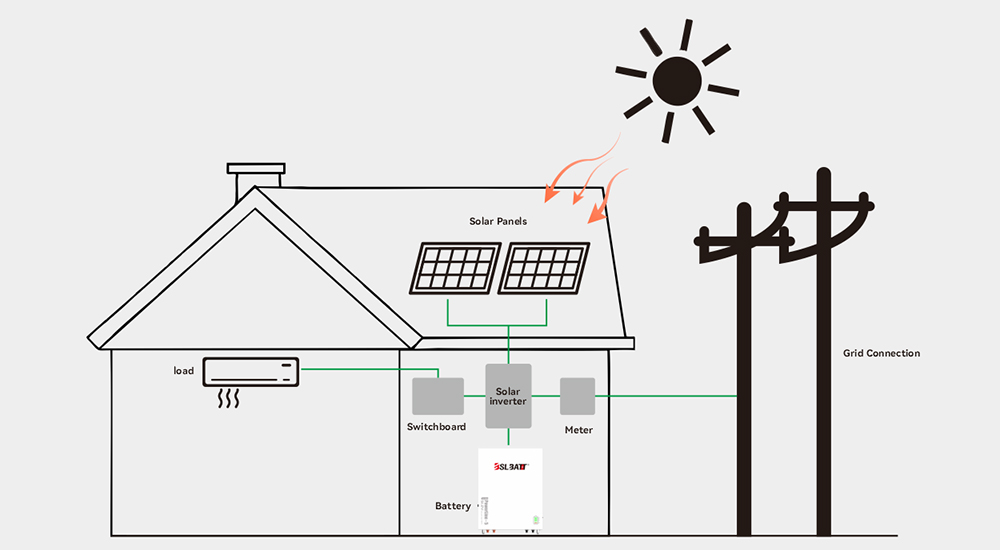
A5: Yes, if your solar PV system is generating more power than your AC (and other household loads) are consuming, the excess solar energy can simultaneously charge your battery. A hybrid inverter manages this power flow, prioritizing loads, then battery charging, then grid export (if applicable).
Post time: May-12-2025