





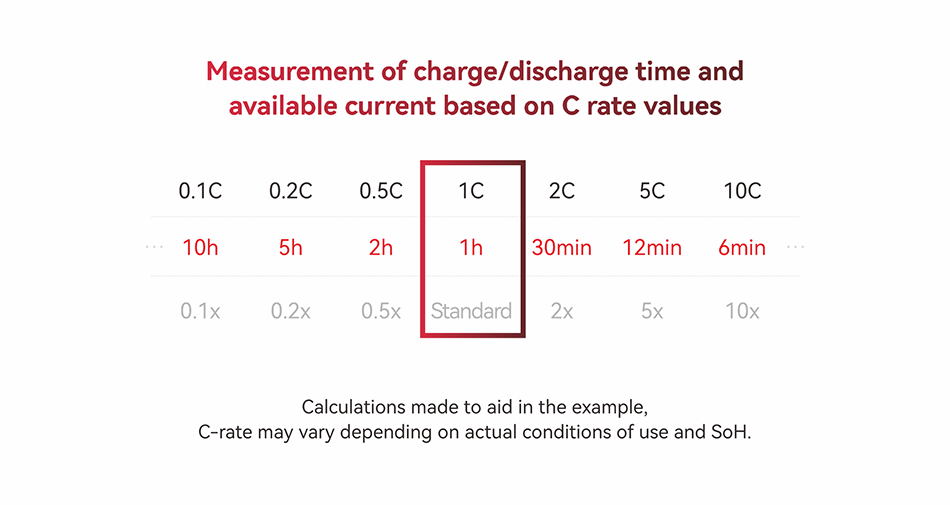
The C rate is a very important figure in lithium battery specifications, it is a unit used to measure the rate at which a battery is charged or discharged, also known as the charge/discharge multiplier. In other words, it reflects the relationship between the discharging and charging speed of Lithium battery and its capacity. The formula is: C Ratio = Charge/Discharge Current / Rated Capacity.
How to understand Lithium battery C Rate?
Lithium batteries with a coefficient of 1C means: Li-ion batteries can be fully charged or discharged within one hour, the lower the C coefficient is, the longer the duration is. The lower the C factor, the longer the duration. If the C factor is higher than 1, the lithium battery will take less than one hour to charge or discharge.
For example, a 200 Ah home wall battery with a C rating of 1C can discharge 200 amps in one hour, while a home wall battery with a C rating of 2C can discharge 200 amps in half an hour.
With the help of this information, you can compare home solar battery systems and reliably plan for peak loads, such as those from energy-intensive appliances like washers and dryers.
In addition to this, the C rate is a very important parameter to consider when selecting a lithium battery for a particular application scenario. If a battery with a lower C rate is used for a high current application, the battery may not be able to deliver the required current and its performance may be degraded; on the other hand, if a battery with a higher C rating is used for a low current application, it may be over-utilized and may be more expensive than necessary.
The higher the C rating of a lithium battery, the faster it will supply power to the system. However, a high C rating can also lead to shorter battery life and increased risk of damage if the battery is not properly maintained or used.
Time Required to Charge and Discharge Different C Rates
Assuming that the specification of your battery is 51.2V 200Ah lithium battery, refer to the following table to calculate its charging and discharging time:
| Battery C rate | Charge and Discharge Time |
| 30C | 2 minutes |
| 20C | 3 minutes |
| 10C | 6 minutes |
| 5C | 12 minutes |
| 3C | 20 minutes |
| 2C | 30 minutes |
| 1C | 1 hour |
| 0.5C or C/2 | 2 hours |
| 0.2C or C/5 | 5 hours |
| 0.3C or C/3 | 3 hours |
| 0.1C or C/0 | 10 hours |
| 0.05c or C/20 | 20 hours |
This is only an ideal calculation, because of the C rate of lithium batteries varies depending on temperature Lithium batteries have a lower C rating at lower temperatures and a higher C rating at higher temperatures. This means that in colder climates, a battery with a higher C rating may be needed to provide the required current, while in hotter climates, a lower C rating may be sufficient.
So in hotter climates, lithium batteries will take less time to charge; conversely, in cooler climates, lithium batteries will take longer to charge.
Why is the C Rating Important for Solar Lithium Batteries?
Solar lithium batteries are an excellent choice for off-grid solar systems because they offer several advantages over traditional lead-acid batteries, including higher energy density, longer lifespan, and faster charging times. However, to take full advantage of these benefits, you need to choose a battery with the right C rating for your system.
The C rating of a solar lithium battery is important because it determines how quickly and efficiently it can deliver power to your system when it’s needed.
During periods of high energy demand, such as when your appliances are running or when the sun isn’t shining, a high C rating can ensure that your system has enough power to meet your needs. On the other hand, if your battery has a low C rating, it may not be able to deliver enough power during peak demand periods, leading to voltage drops, reduced performance, or even system failure.
What is the C rate for BSLBATT batteries?
Based on market-leading BMS technology, BSLBATT provides customers with high C-rate batteries in Li-ion solar energy storage systems. BSLBATT’s sustainable charging multiplier is typically 0.5 – 0.8C, and its sustainable discharging multiplier is typically 1C.
What is The Ideal C Rate for Different Lithium Battery Applications?
The C rate required for different lithium battery applications is different:
- Starting Lithium batteries: Starting Li-ion batteries are required to provide power for starting, lighting, ignition and power supply in vehicles, ships and airplanes, and are usually designed to be discharged at several times the C discharge rate.
- Lithium Storage Batteries: Storage batteries are mainly used to store power from the grid, solar panels, generators, and to provide backup when needed, and usually do not require a high discharge rate, as most lithium storage batteries are recommended to be used at 0.5C or 1C.
- Material Handling Lithium Batteries: These lithium batteries can be useful in handling equipment such as forklifts, GSE’s, etc. They usually need to be recharged quickly to fulfill more work, reduce costs and increase efficiency, so they are recommended to require 1C or higher C.
C rate is an important consideration when selecting Li-ion batteries for different applications, which helps to understand the performance of Li-ion batteries under different conditions. Lower C rates (e.g., 0.1C or 0.2C) are usually used for long-term charge/discharge testing of batteries to evaluate performance parameters such as capacity, efficiency, and lifetime. While higher C-rates (e.g. 1C, 2C or even higher) are used to evaluate battery performance in situations requiring fast charge/discharge, such as electric vehicle acceleration, drone flights, etc.
Choosing the right lithium battery cell with the right C-rate for your needs ensures that your battery system will provide reliable, efficient and long-lasting performance. Not sure how to choose the right Lithium battery C rate, contact our engineers for help.
FAQ about Lithium Battery C- Rating
Is higher C-rating better for Li-ion batteries?
No. Although high C-rate can provide faster charging speed, it will also reduce the efficiency of Li-ion batteries, increase the heat, and reduce the battery life.
What are the factors affecting the C-rating of Li-ion batteries?
The capacity, material and structure of the cell, the heat dissipation ability of the system, the performance of the battery management system, the performance of the charger, the external ambient temperature, the SOC of the battery, etc. All of these factors will affect the C rate of lithium battery.
Post time: Sep-13-2024