





A 15kWh home battery costs about €5,900 installed in Germany and A$15,000 to A$20,000 in Australia before the federal rebate. LiFePO4 battery manufacturer BSLBATT breaks down below what that price covers, from the battery and inverter to backup equipment and labour, and how to tell whether a quote is fair.
Why 15kWh Battery Prices Range So Widely
Search for a 15kWh LiFePO4battery price and you will see offers from under €2,000 to well over €10,000. The batteries carry the same "15kWh" label, but the prices often cover different things:
- The battery alone, or a finished installation
- With or without a hybrid inverter
- With or without backup power for outages
- Nominal capacity, or usable capacity (a 15.36kWh battery may deliver about 14.6kWh)
- One 51.2V low voltage unit, or a stack of high voltage modules
Before comparing two prices, check that both quotes cover the same scope. The rest of this guide shows what an installed system costs, what the price includes and what moves it up or down.
15kWh Battery Price: Installed Examples
What a homeowner pays for an installed 15kWh solar battery depends heavily on the country. Labour rates, VAT or GST, grid connection rules and incentives all differ. The two markets below publish regularly updated installed prices.
| Market | 15kWh installed price | What the price covers | Source |
| Germany | About €5,900 (€390/kWh) | A complete installation, from end-customer offers | Echtsolar storage cost index, Oct 2026 |
| Australia | A$15,000 to A$20,000 including GST; A$11,040 to A$16,040 after the A$3,960 federal rebate | A complete installation, from accredited installer quotes | whysolar, quotes checked Sep 2026 |
Both figures cover a working system, not just the battery. In other markets, treat them as reference points and ask local installers for quotes with the same scope.
Prices are still lower than a year ago, but the steep falls are over. German installed prices dropped 27% in 2024 and 17% in 2025, and have moved by only a few euros a month since mid-2026. Waiting for a big price drop is unlikely to pay off; ask your installer for a quote validity date instead.
Is a Bigger Battery Cheaper per kWh?
Yes, slightly. The German index puts installed prices at €448/kWh for 5kWh and €390/kWh for 15kWh, because installation and electrical work cost about the same for each size.
| Battery size | Installed price per kWh | Typical installed price |
| 5kWh | €448 | About €2,200 |
| 10kWh | €411 | About €4,100 |
| 15kWh | €390 | About €5,900 |
| 20kWh | €376 | About €7,500 |
For the smaller size in this series, see how much a 10kWh battery costs.
Low Voltage vs High Voltage: Why the Same 15kWh Can Cost Three Times More

The largest price gap between 15kWh batteries comes from the voltage class. European marketplace data from September 2026 shows premium high voltage home batteries selling at about 3.3 times the price per kWh of low voltage batteries, with other high voltage brands in between.
| Low voltage (48V / 51.2V) | High voltage (stacked modules) | |
| Relative price per kWh, Sep 2026 | 1× | About 1.6× (performance brands) to 3.3× (premium brands) |
| Inverter | 48V hybrid or off-grid inverter | High voltage hybrid inverter, often from the same brand |
| How capacity is added | Identical units in parallel | Modules stacked in series under one control box |
| Typical fit | Single-phase homes, off-grid sites, small businesses, retrofits with 48V inverters | Three-phase homes and larger loads where lower current and matched systems matter |
High voltage systems connect modules in series under a control box and work with high voltage hybrid inverters. They carry less current at the same power, and premium brands sell the battery and inverter as one matched system. That engineering and brand ecosystem is part of the price.
Low voltage batteries suit most single-phase homes and many small businesses. A 51.2V battery works with a wide range of 48V hybrid and off-grid inverters, and capacity grows by adding identical units in parallel. For a fuller comparison, see high voltage vs low voltage batteries.
What a Complete 15kWh Battery Installation Includes
Most 15kWh lithium battery prices you see online cover the battery alone. What else the installation needs depends on the home.
Battery Only: When the Home Already Has an Inverter
If the home already has a hybrid inverter, adding a battery is the simplest and lowest-cost route. The battery and inverter must communicate over CAN or RS485 using a protocol the inverter supports, so the inverter has to be on the battery's compatibility list. If it is not, the inverter may need replacing; a German retrofit guide estimates €1,500 to €3,000 for a new hybrid inverter.
Battery + Inverter: What Else the Quote Covers
A new installation, or one with backup power, includes more than the battery and inverter. The table lists the usual items and German installer estimates for each.
| Item | Typical cost | When it applies |
| Hybrid inverter, new or replacement | €1,500 to €3,000 | No inverter yet, or the existing one is not compatible |
| Backup-capable inverter | €500 to €2,000 more than a standard hybrid inverter | The home needs power during grid outages |
| Backup switch box | €500 to €1,500 | Systems with backup; price depends on the brand and on single-phase or three-phase |
| Backup circuit wiring | €500 to €1,500 | Systems with backup, to feed a dedicated emergency circuit |
| Meter cabinet upgrade | €500 to €2,000 | No free space for the inverter or an extra meter |
| Smart meter | €100 to €300 | Required in Germany for PV systems from 7kWp |
| Grid operator notification | €200 to €500 | Electrician's paperwork for the grid connection |
| Installation labour | €1,000 to €2,000 | Every installation; depends on cable runs and the site |
The figures come from German installer guides (photovoltaik.info and reduco), so use them as a checklist of what a full quote should cover rather than a price list for every market.
Backup is the item that moves the price most. It typically adds €1,500 to €5,000, which explains why two quotes for the same battery can differ by several thousand euros. A quote that lists each item is easier to compare than a single total.
Low voltage systems need one more thing done right. A 5kW inverter running from a 51.2V battery draws about 100A, so the DC side needs heavy cables, a DC breaker or fuse, and short cable runs.
All-in-One Cabinet: Fewer Parts to Buy and Connect
An all-in-one cabinet puts the battery, hybrid inverter and surge protection in one housing, integrated at the factory. That removes the compatibility check and part of the on-site wiring, and one supplier covers the whole unit. The trade-off is a fixed inverter size.
BSLBATT 15kWh Batteries for Each Option
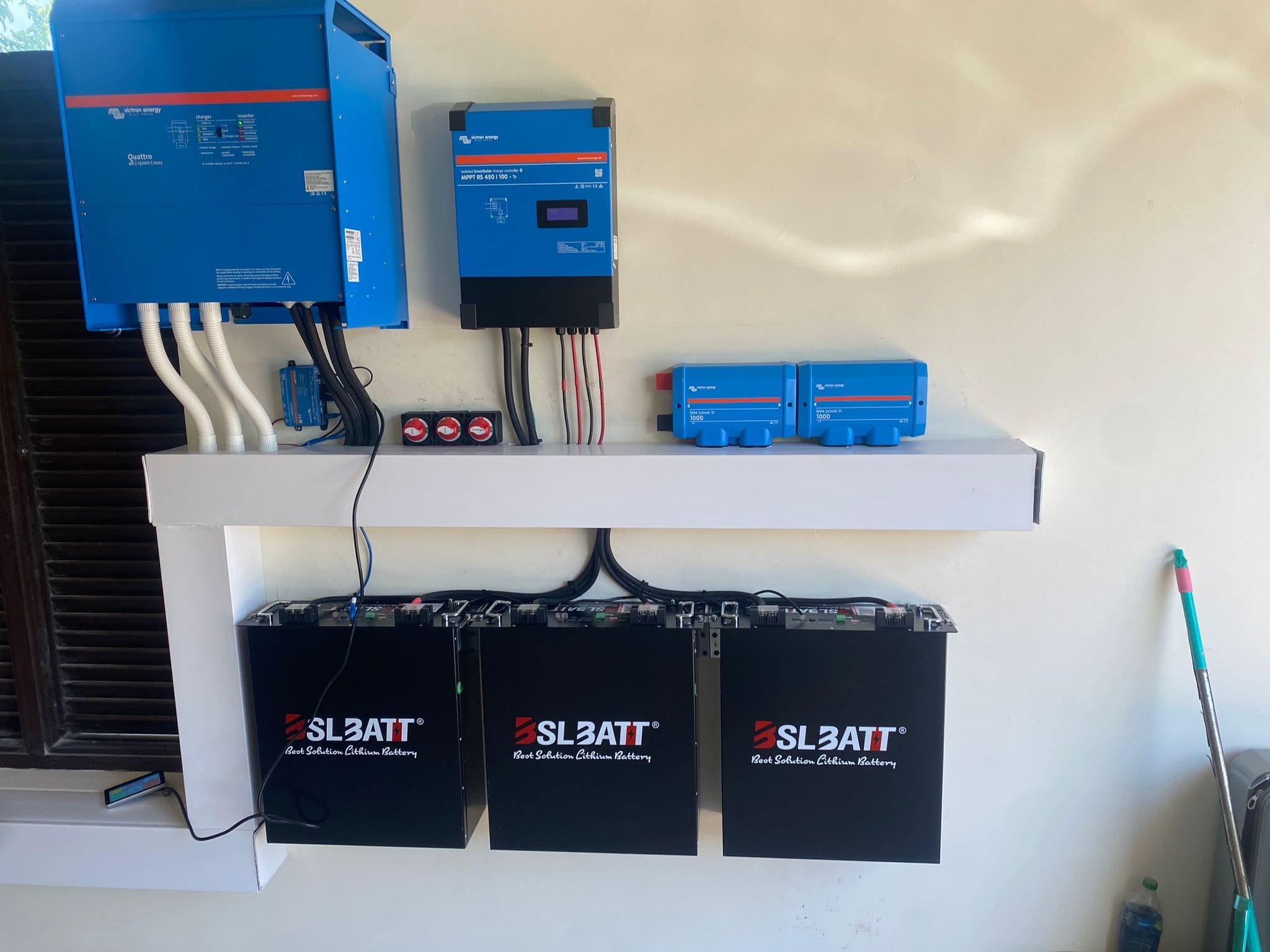
BSLBATT supplies its 15kWh range through installers and distributors, in three battery-only formats and one all-in-one cabinet.
Wall or floor-standing
The B-LFP48-300PW is a 48V 300Ah LiFePO4 battery. It stores 15.36kWh (14.59kWh usable) and mounts on a wall or stands on wheels. It is rated for more than 8,000 cycles at 25±2°C and 0.5C, and up to 32 units connect in parallel.
Rack or battery cabinet
The B-LFP48-300E is a 5U 51.2V 300Ah battery. It suits installers who build battery cabinets or replace older rack systems. Up to 63 units connect in parallel, and its manual lists more than 30 compatible inverter brands.
Outdoor
The Li-Pro StyX is a 16kWh battery with an IP65 enclosure. It uses 314Ah cells, is rated for 8,000+ cycles, and is built for garages, sheds and outdoor installation.
All-in-one
The PowerNest LV15 is a 15kWh battery and inverter cabinet. It combines three 5.12kWh battery packs and a 5kW inverter in one IP55 cabinet, with utility, PV and generator inputs.
What Else Changes the Price of a 15kWh Battery
Two 15kWh batteries at the same voltage can still be priced far apart. These are the main reasons.
Cell Grade and Cycle Rating
A cycle rating only means something with its test conditions. Look for the temperature, charge rate and depth of discharge behind the number. A higher rating from a stated test usually costs more up front and less per stored kWh.
Indoor or Outdoor Enclosure
An indoor IP20 battery uses a simple steel housing. An IP65 battery adds sealing and a stronger enclosure for dust, rain and humidity, which raises the price but removes the need for indoor space.
Certifications and Local Listings
Every market has its own requirements, from safety standards such as IEC 62619 to grid rules and local approved-product lists. A battery without the right listing may be cheaper but cannot be connected in that market. See which certifications apply in our guide to export certifications for LiFePO4 batteries.
Warranty Terms
Compare the years and cycles covered, the capacity guaranteed at the end of the warranty, and who handles claims in your country. Local stock and after-sales support reduce downtime when a unit needs service.
Import Costs and Taxes
Lithium batteries ship as dangerous goods, and import tariffs and freight can raise storage costs by 15% to 35% in emerging markets, according to ESI Africa. VAT or GST on home batteries also differs by country, and some markets reduce it for solar storage.
What a Stored kWh Really Costs: Battery vs Grid Electricity
For a homeowner, the real question is whether electricity from the battery is cheaper than electricity from the grid. The answer is the cost per stored kWh: the installed price divided by the energy the battery delivers over its life, which is capacity × cycles × depth of discharge.
The example uses the German installed price and assumes one cycle on most days for 15 years, about 4,500 cycles, at 90% depth of discharge. Over that life, the battery delivers about 60,750kWh. Many LFP batteries are rated for more cycles, so this is a conservative figure.
In Germany, a stored kWh costs a little over a quarter of the grid price. To check another market, put the local installed price and electricity price into the same formula.
Three things narrow the gap:
- Solar energy stored in the battery is not free if the household could have exported it for a feed-in tariff.
- Round-trip losses mean slightly less energy comes out than goes in.
- Where grid electricity is cheap, such as Hungary at €0.11 per kWh, the case for a battery rests more on backup than on savings
The figure also leaves out financing, so it is a way to compare options rather than a full levelized cost.
How to Compare 15kWh Battery Quotes
These checks put quotes that look similar on paper on the same basis.
| Check | What to ask |
| Usable energy | Nominal and usable kWh, and the price per usable kWh |
| Scope | Battery only, or with inverter, backup, wiring, monitoring and installation? |
| Cycle life | Number of cycles, and at what temperature, C-rate and depth of discharge |
| Warranty | Years and cycles covered, the capacity left at the end, and who handles claims locally |
| Inverter | Which inverter brands and models are on the battery's compatibility list |
| Installation | Who installs, registers and commissions the system, and how long it takes |
Compare the price per usable kWh, with the same scope in every quote. For example, €5,900 for a 15kWh battery used at 90% depth of discharge is about €437 per usable kWh.
15kWh Battery Price FAQ
Q: How much does a 15kWh battery cost?
It depends on the country and on what the quote covers. An installed 15kWh home battery costs about €5,900 in Germany and A$15,000 to A$20,000 in Australia before the A$3,960 federal rebate. Backup power, a new inverter or a meter cabinet upgrade can add several thousand more. BSLBATT supplies 15kWh LiFePO4 batteries in wall, rack, outdoor and all-in-one formats.
Q: Does a 15kWh battery price include an inverter?
Not always. Battery-only prices cover the battery alone, which connects to a separate hybrid inverter. If the home needs a new inverter, a German retrofit guide estimates €1,500 to €3,000. All-in-one cabinets such as BSLBATT's PowerNest LV15 include a 5kW inverter in the same unit.
Q: Is battery electricity cheaper than grid electricity?
Usually, where grid prices are high. In Germany, a 15kWh battery installed for about €5,900 and cycled most days for 15 years stores energy for about €0.10 per kWh, against a household grid price of €0.36 per kWh in the first half of 2026. Feed-in tariffs, round-trip losses and low local tariffs narrow the gap.
Q: Is a 15kWh battery cheaper per kWh than a 10kWh battery?
Slightly. A German installed price index puts a 10kWh battery at €411/kWh and a 15kWh battery at €390/kWh, because installation and electrical work cost about the same for each size. Size the battery from your evening and backup needs, not from the price per kWh alone.
Q: Why are some 15kWh batteries sold online so cheaply?
Online prices usually cover the battery alone, delivered to the door, without an inverter, installation, grid registration or local warranty service. Prices also reflect differences in cell grade, BMS quality and certifications. Compare the full installed scope, and ask who handles warranty claims in your country.
Q: How long will a 15kWh battery power a house?
Divide the usable energy by the average load. A 15kWh battery with about 14kWh usable runs a 1kW average load for roughly 14 hours, or a 500W load overnight and into the next day. For daily usage examples, see how long a 15kWh battery lasts off-grid.
Q: Should I choose a 15kWh or 16kWh battery?
Compare usable energy, the installation site and the price per usable kWh rather than the label. A 51.2V 300Ah battery stores 15.36kWh and a 51.2V 314Ah battery about 16kWh. BSLBATT's B-LFP48-300PW suits indoor wall or floor installation, while the Li-Pro StyX adds an IP65 enclosure for outdoor sites.
Get a 15kWh Battery Quote You Can Compare
A useful quote states the usable kWh, the cycle rating and its test conditions, and exactly what the installation includes. BSLBATT supplies a 15kWh battery in wall, rack, outdoor and all-in-one formats. Installers and distributors receive each configuration matched to the inverter and load profile, with local warehouse and after-sales support and delivery in about 8 weeks from order. Send your inverter model, typical daily usage and installation site to request a 15kWh battery quote.

Marketing Director| Focused on ESS · BSLBATT
Aydan is a Marketing Director and energy storage specialist at BSLBATT, focusing on residential, commercial, and off-grid battery solutions. He works closely with solar distributors, installers, and EPC companies across global markets, supporting the design and deployment of reliable energy storage systems.
Post time: Nov-03-2026