




Project Summary
BSLBATT supplied a 52.2 kWh MatchBox LVS low voltage stackable battery system for a family home in Curaçao. Ten 5.22 kWh LiFePO4 modules, stacked into towers and connected in parallel at 51.2V, work with a low voltage hybrid inverter.
The system stores surplus rooftop solar for the evening and keeps the house powered when the island grid goes down, a frequent need on Curaçao when wind output drops.
The Challenge
Curaçao's grid relies on a mix of oil-fired power plants and roughly 70 MW of wind farms. Wind output can swing sharply, and when it falls while several conventional units are out of service, the utility Aqualectra has to balance supply with rotating outages across neighborhoods, known locally as "schakel".
These interruptions tend to hit in the evening, when island demand peaks at around 140 MW and solar has stopped producing. Each affected area can lose power for up to three hours at a time.
For this homeowner, rooftop solar alone did not solve the problem: panels produce at midday, while outages and the household's heaviest loads come after sunset. They needed a battery large enough to carry the home through the evening and night, and to ride out a load-shedding period without switching anything by hand.
The homeowner also wanted a system that is simple to install in a residential setting and can grow later.
The Solution
BSLBATT supplied ten MatchBox LVS modules, each rated at 51.2V 102Ah (5.22 kWh), stacked into towers and connected in parallel. Together they provide 52.2 kWh of nominal storage and 46.98 kWh of usable capacity at 90% depth of discharge.
Because every tower runs at the same 51.2V, capacity adds up without changing the system voltage. The modules stack plug-and-play, so there is no module-to-module cabling to run on site.
The battery communicates with the low voltage hybrid inverter over CAN or RS485. During the day, the inverter covers household loads from solar first and charges the battery from the surplus. After sunset, the battery supplies the home. When the grid drops out, the inverter switches to backup mode and the battery keeps the house running.
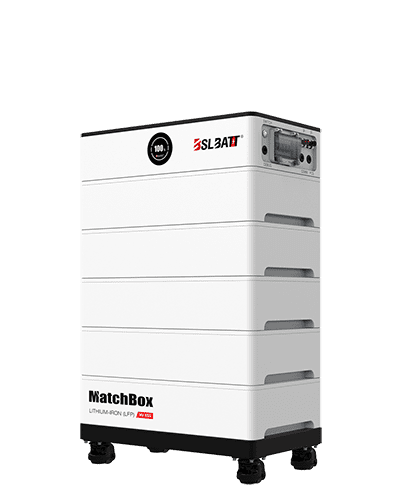
The MatchBox LVS is rated IP65, which suits the humid, salty air of a coastal Caribbean home. It discharges at up to 55°C, and each tower sits on integrated wheels for easy positioning during installation.
| Specification | Detail |
|---|---|
| Configuration | 10 modules in stacked towers, connected in parallel |
| Total Nominal Capacity | 52.2 kWh |
| Total Usable Capacity | 46.98 kWh (90% DoD) |
| Rated Voltage | 51.2V (range 44.8 to 57.6V) |
| Battery Module | 51.2V 102Ah, 5.22 kWh, LiFePO4 |
| Max. Charge / Discharge Current | 240A / 240A per tower |
| Cycle Life | >6,000 cycles @ 90% DoD (25°C) |
| Operating Temperature | Charge: 0 to 45°C / Discharge: -20 to 55°C |
| Protection Level | IP65 |
| Communication | CAN / RS485; WiFi and Bluetooth optional |
| Certification | CE, UN38.3 |
| Warranty / Service Life | 10 years / 15 to 20 years |
Results
Since installation, the household runs mainly on its own solar energy and no longer depends on the grid during the evening peak, when supply on the island is tightest.

Power through rotating outages.
When a load-shedding period hits the neighborhood, the inverter switches to backup mode automatically and the 46.98 kWh usable reserve carries the home well beyond a typical three-hour outage window.
More of the home's own solar used at home.
Surplus PV generation that would otherwise flow to the grid at midday is stored and used after sunset, covering evening lighting, cooling and appliances..
Room to grow.
The stacked design lets the homeowner add capacity later as PV or household loads grow, by adding modules or towers at the same 51.2V.
FAQ: Low Voltage Home Battery Storage
Q: Why choose a low voltage stackable battery for a home?
A low voltage battery such as the BSLBATT MatchBox LVS runs at 51.2V, the standard battery voltage for most residential hybrid inverters. Capacity grows by adding modules or towers in parallel while the voltage stays the same, so the battery can expand without changing the inverter. High voltage systems suit larger three-phase inverters; for many homes, especially on single-phase supply, a low voltage system is the simpler match.
Q: How long can a 50 kWh home battery run a house during an outage?
Divide usable capacity by the home's average load. This system has 46.98 kWh usable, so at an average load of 2 kW it can run for about 23 hours, and at 4 kW for about 11.7 hours. Large loads such as air conditioning shorten that time, so many homeowners put essential circuits on backup and leave the heaviest loads off during outages.
Q: Can the MatchBox LVS be installed in a hot, humid island climate?
Yes. The BSLBATT MatchBox LVS is rated IP65 against dust and water, and it discharges from -20°C to 55°C and charges from 0°C to 45°C. In hot coastal locations, a shaded, well-ventilated spot keeps the battery within its charging range and helps it reach its rated 6,000+ cycles.
Low Voltage Home Battery Storage for Island Grids
The Curaçao project shows how the BSLBATT MatchBox LVS helps homes on island grids where supply can tighten without warning. Stacked 51.2V towers store a full day of solar, cover the evening peak and keep the house running through rotating outages. With IP65 protection, 6,000+ cycles and a 10-year warranty, it gives island households a dependable base for solar self-consumption that can grow with their needs.