




Project Summary
BSLBATT deployed a 42.58 kWh MatchBox HVS high-voltage stackable battery system at a residential property in Aruba, paired with Deye high-voltage hybrid inverters. Configured as two HVS4 units in parallel, the system integrates with rooftop solar to maximize self-consumption and deliver genuine off-grid backup capability during grid outages — addressing both the high cost of grid electricity and the island's dependence on imported fossil fuels.
The Challenge
Aruba's electricity rates are among the highest in the Caribbean, driven by the island's reliance on imported heavy fuel oil and diesel for over 80% of its power generation. For residential users, this means monthly electricity bills that directly track global fuel prices, with limited ability to manage or reduce consumption through conventional means.
Beyond cost, Aruba's grid presents reliability challenges. As the island increases its share of wind and solar generation toward its 100% renewable energy target, supply-demand mismatches during low-wind or high-demand periods can cause voltage fluctuations and intermittent outages. For homeowners investing in rooftop solar, a battery system is essential to capture daytime generation for use at night and to maintain power during grid interruptions.
The homeowner in this project required a system that could store meaningful solar energy across a full day-night cycle, support Deye's high-voltage inverter architecture, and scale as energy needs grow. All within the physical constraints of a residential installation.
The Solution
BSLBATT configured a two-unit MatchBox HVS4 system in parallel to meet the site requirements. Each HVS4 consists of four 32S1P battery modules (102.4V, 52Ah per module), delivering 21.29 kWh of nominal capacity at 409.6V. With two units operating in parallel, the system provides 42.58 kWh of total nominal storage and 40.44 kWh of usable capacity at 95% depth of discharge.
The system was integrated with Deye high-voltage hybrid inverters, which are factory-compatible with the MatchBox HVS series via CAN BUS communication. During daylight hours, the inverter prioritizes solar self-consumption and charges the battery from surplus PV generation. After sunset, stored energy powers household loads. When grid power is unavailable, the system switches to off-grid backup mode, maintaining continuous supply to essential circuits.
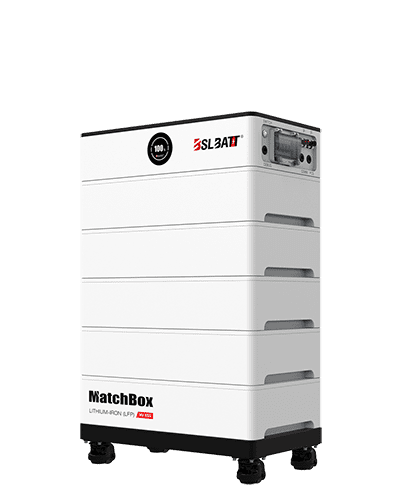
The MatchBox carries an IP65 rating, making it suitable for installation in locations subject to humidity and dust common in coastal Caribbean environments. Each unit is mounted on integrated wheels for straightforward positioning, and the stackable modular design means the system can be expanded by adding further HVS units in parallel as the household's energy needs increase, up to a maximum of five towers.
| Specification | Detail |
|---|---|
| Configuration | 2 × HVS4 in parallel |
| Total Nominal Capacity | 42.58 kWh |
| Total Usable Capacity | 40.44 kWh (95% DoD) |
| System Voltage | 409.6V |
| Cell Chemistry | LiFePO4, 52Ah prismatic cells |
| Battery Pack | 32S1P, 102.4V per module |
| Modules per Unit | 4 (8 modules total) |
| Max. Charge Current | 96A (2 × 48A) |
| Max. Discharge Current | 104A (2 × 52A) |
| Cycle Life | >6,000 cycles @ 95% DoD |
| Operating Temperature | Charge: 0 to 50°C / Discharge: -10 to 55°C |
| Protection Level | IP65 |
| Communication | CAN BUS / Modbus RTU / WiFi / Bluetooth |
| Compatible Inverter | Deye High-Voltage Hybrid Inverter |
| Max. Expandability | Up to 5 towers in parallel |
| Warranty | 10 years |
Results
Since installation, the system has reduced the household's dependence on Aruba's grid and lowered monthly electricity costs by shifting consumption to solar-generated energy stored during daylight hours. Key outcomes include:

Maximized solar self-consumption.
The MatchBox HVS system captures surplus PV generation that would otherwise be exported to the grid at unfavorable net metering rates. Stored energy covers evening and nighttime household loads, reducing grid purchases during the highest-cost periods.
Reliable off-grid backup.
During grid outages, the system switches to backup mode and maintains power to household loads from the 40.44 kWh usable reserve. The Deye hybrid inverter manages the transition automatically, with no manual intervention required.
Scalable foundation for growing energy needs.
Starting with two HVS4 units, the homeowner retains the option to add further towers as rooftop PV capacity or household consumption increases. The parallel architecture supports expansion to five towers without replacing any existing equipment.
FAQ: Residential High-Voltage Battery Storage
Q: Why choose a high-voltage battery system for a residential installation?
High-voltage battery systems like the BSLBATT MatchBox HVS operate at 307V to 716V, which reduces the current flowing through inverter and wiring connections compared to 48V low-voltage systems of similar capacity. Lower current means reduced resistive losses, lower heat generation in cables, and higher system-level efficiency. For residential installations pairing a high-voltage battery with a compatible hybrid inverter, this translates to more usable energy from each charge cycle and lower long-term operating costs.
Q: How does the MatchBox HVS integrate with Deye inverters?
BSLBATT MatchBox HVS units communicate with Deye high-voltage hybrid inverters via CAN BUS protocol. The inverter reads state-of-charge, cell temperature, voltage, and current data from the battery BMS in real time, enabling precise charge and discharge control. The integration is factory-validated, requiring no custom configuration at the installation site. Monitoring of both the inverter and battery system is available through the inverter's WiFi-connected app.
Q: Can the MatchBox HVS expand beyond the initial two-unit installation?
Yes. The MatchBox HVS supports parallel connection of up to five towers. Each additional HVS4 adds 21.29 kWh of nominal capacity, bringing a five-tower system to 106.45 kWh. Additional units connect to the same inverter without requiring changes to the existing wiring architecture, provided the inverter's rated capacity supports the expanded storage. This makes the MatchBox HVS a practical starting point for homeowners who anticipate increasing their solar generation or household load over time.
Modular High-Voltage Storage for Caribbean Residential Solar
The Aruba deployment demonstrates how the BSLBATT MatchBox HVS addresses the specific challenges of island residential energy: high grid electricity costs, dependence on imported fossil fuels, and the need for reliable backup during supply interruptions. With IP65 protection for coastal environments, factory-validated Deye inverter compatibility, and a scalable architecture reaching 106 kWh across five towers, the MatchBox HVS provides a long-term platform for residential solar self-sufficiency in the Caribbean and beyond.