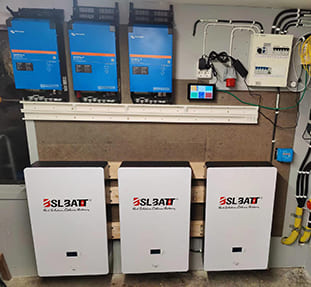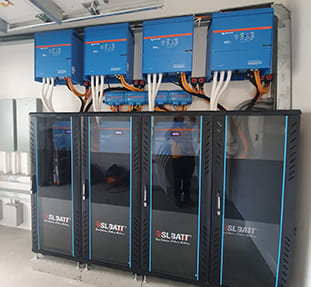



51.2V 300Ah Rack Mount LiFePO4
Battery for Home & Commercial ESS
The B-LFP48-300E is a 51.2V 300Ah LiFePO4 rack mount battery delivering 15.36kWh of energy storage per unit with 95% depth of discharge. Built for residential and commercial applications, it supports parallel expansion from 15.36kWh up to 967.68kWh across 63 units — with built-in WiFi, Bluetooth, and multi-protocol communication for seamless inverter integration and remote monitoring.


51.2V 300Ah Rack Battery: 15.36kWh per Module, Up to 967.68kWh
Each B-LFP48-300E module stores 15.36kWh, and its 95% depth of discharge leaves 14.59kWh usable, about 19% more than a battery of the same size limited to 80% DoD. At 5U high, it fits a standard 19-inch rack or battery cabinet, so a 15kWh system needs one module instead of three.
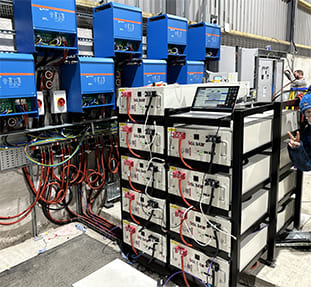
Rated discharge is 200A (10.24kW) per module, with short peaks to 250A for one second. Up to 63 modules run in parallel for 967.68kWh. The master module collects data from the others and reports to the inverter, so the whole bank works as one battery.
CAN and RS485 connect it to 30+ inverter brands. The mobile app reads it over WiFi or Bluetooth, and RS232 links to PC software for diagnostics and firmware updates, with no separate gateway.
Inside are 16 Grade A prismatic LiFePO4 cells, rated for more than 6,000 cycles at 25°C and a design life of over 15 years, backed by a 10-year warranty.
Safety
- Cobalt-free LiFePO4 chemistry
- CE, IEC 62619 & UN38.3 certified
Reliability
- 6,000+ cycles at 25°C
- 95% depth of discharge
Warranty
- 10-year product warranty
- Dedicated after-sales technical support
Flexibility
- Parallel expansion up to 63 units
- Compatible with 30+ inverter brands
Monitoring
- WiFi & Bluetooth app monitoring
- CAN and RS485, no separate gateway
Quality
- Grade A LiFePO4 cells
- 15.36kWh in one 5U module
WiFi and Bluetooth Monitoring, No Separate Gateway
Pair the B-LFP48-300E with the mobile app over Bluetooth, then connect it to a 2.4GHz WiFi network to check battery status from anywhere. The inverter reads battery data over CAN or RS485, and RS232 connects to PC software for diagnostics and firmware updates.
15.36kWh in One 5U Module
Many 48V rack systems reach 15kWh by stacking three 5kWh modules. The B-LFP48-300E puts 15.36kWh in a single 5U unit (483 × 780 × 222mm), so a bank needs fewer modules, cable sets and BMS addresses for the same energy. Larger projects scale to 967.68kWh with 63 units in parallel.
Solar Self-Consumption and Backup Power at Home
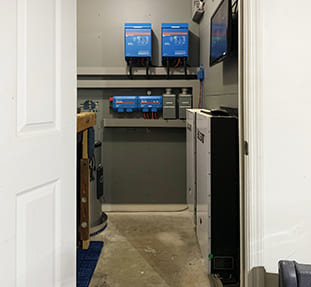
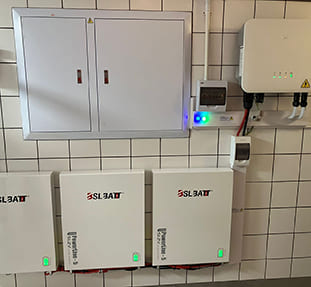
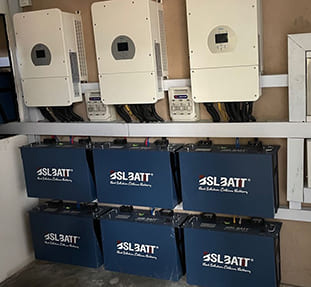
Paired with a hybrid inverter, the B-LFP48-300E stores daytime solar for evening use, shifts grid charging to off-peak hours where time-of-use tariffs apply, and powers household loads during outages. One module covers a typical 2kW household load for about 7 hours before inverter losses.
Schools and Public Buildings
Solar charges the bank during school hours, and the stored energy covers lighting, IT equipment and evening programs. Many schools run on three-phase supply, and the compatibility list below includes three-phase low-voltage hybrid inverters from Deye, Solis, LuxPower, SolaX and SOSEN.
Off-Grid Sites and Island Resorts
With an off-grid inverter, the B-LFP48-300E stores solar energy for sites with weak or no grid connection and cuts diesel generator runtime. It discharges from -20°C to 55°C and charges from 0°C to 55°C.
Farms and Agricultural Loads
Irrigation pumps, lighting and cold storage draw power around the clock. Each module supplies 200A rated discharge (10.24kW), and parallel modules share the load, so a farm bank can grow with the operation instead of being replaced.
Choosing a B-LFP48 Rack Battery: 100E 3U vs 200E vs 300E
All three B-LFP48 rack batteries share the same 51.2V platform, 95% DoD, communication ports and inverter protocols, so they can be planned with the same inverter. They differ in energy per module, depth and weight.
| Model | B-LFP48-100E 3U | B-LFP48-200E | B-LFP48-300E |
| Capacity | 100Ah | 200Ah | 300Ah |
| Nominal energy | 5.12kWh | 10.24kWh | 15.36kWh |
| Usable energy (95% DoD) | 4.86kWh | 9.73kWh | 14.59kWh |
| Height | 3U (136mm) | 5U (222mm) | 5U (222mm) |
| Depth | 540mm | 590mm | 780mm |
| Weight | 43kg | 79kg | 111kg |
| Rated discharge | 100A / 5.12kW | 200A / 10.24kW | 200A / 10.24kW |
| Max. units in parallel | 63 | 63 | 63 |
The 200E and 300E share the same 200A rated discharge, so the 300E adds 50% more energy per module at the same power. Choose it when runtime matters more than peak power, or when rack slots are limited. For smaller steps of 5.12kWh, see the B-LFP48-100E 3U server rack battery; for 10.24kWh per module, see the B-LFP48-200E 48V 200Ah rack battery.
The 300E is built for racks and battery cabinets. For a 48V 300Ah battery that stands on the floor or mounts on a wall, see the B-LFP48-300PW wall and floor-standing battery.
B-LFP48-300E Compatible Inverters: Single-Phase and Three-Phase
The BSLBATT B-LFP48-300E is listed as compatible by 20 inverter brands, including Deye, Solis, LuxPower, SolaX and SOSEN. The list covers both single-phase and three-phase low-voltage hybrid inverters, which matters for the commercial and off-grid projects this 15.36kWh module is built for.
| Inverter Brand | Protocol | Listed Inverter Models |
| Afore | CAN | AF1-3.6K-SL, AF3-3.6K-SL, AF4-6K-SLP, AF8-12K-SLP |
| Deye | CAN / RS485 | SUN-SG04LP1, SG05LP1, SG01LP1, SG02LP1, SG02LP2, SG04LP3 and SG05LP3 series (3-20kW) |
| Epever | RS485 | UC3542, KR3542, UCP3542, KRP3542 and HP2042 series |
| GoodWe | CAN / RS485 | ES Series, ES G2 |
| Growatt | CAN | SPH / SPM HU, SPE, SPF |
| LuxPower | CAN | LXP-LB, GEN-LB, GEN2-LB, TriP2-LB and SNA series (3-20kW) |
| MEGAREVO | CAN | R5-10KLNA, R12KLNA, R16KLNA |
| Phocos | RS485 | Any-Grid PSW-H-5kW-230/48V |
| Sinexcel Isuna | CAN | All LV models |
| SMA | CAN | Sunny Island 4.4M / 6.0H / 8.0H |
| SAJ | CAN | H2 Series |
| Solis | CAN | S6-EH1P(3-10)K-L-PLUS, S6-EH3P(8-18)K02-NV-YD-L |
| Solplanet | CAN | ASW3000 to ASW6000H-S2 |
| SolaX Power | CAN | X3-ULTRA, X1-RENO-LV, X1-Lite-LV |
| SOSEN | CAN | SSA-HL and SSE-HL series (1.2-24kW) |
| SRNE | RS485 | HESP series (3.6-12kW) |
| Studer Innotec | CAN | Next3, Xtender |
| Sunsynk | CAN / RS485 | All models |
| TBB Power | CAN | Riio II, Riio Sun II, Tyrann, Matrix II |
| Victron Energy | CAN | MultiPlus, MultiPlus-II (GX), Quattro, Quattro-II, Multi RS Solar, EasySolar, EasySolar-II GX |
Many schools, farms and small commercial sites run on three-phase supply. The compatibility list includes three-phase low-voltage hybrid inverters from Deye, Solis, LuxPower, SolaX and SOSEN, so a 300E bank can serve these sites as well as single-phase homes.
In a multi-module bank, the master module collects data from the other modules and reports it to the inverter over CAN or RS485. No extra gateway is needed.
Protocol Support for 30+ Inverter Brands
Beyond the listed models, the B-LFP48-300E firmware includes CAN and RS485 communication protocols for 30+ inverter brands. For an inverter model not shown in the table above, send the model number to BSLBATT technical support to confirm the protocol setting before commissioning.
Can the B-LFP48-300E work with a three-phase inverter?
Yes. BSLBATT lists the B-LFP48-300E with several three-phase low-voltage hybrid inverters, including the Deye SUN-SG04LP3 and SG05LP3 series, Solis S6-EH3P(8-18)K02-NV-YD-L, LuxPower TriP2-LB-EU 5-20K, SolaX X3-ULTRA and SOSEN SSE-HL8-24K-P3EU.
Factory-Direct 51.2V 300Ah Rack Mount Batteries for Installers and Distributors
BSLBATT builds the B-LFP48-300E in its own factory and supplies installers, distributors and EPC contractors directly. Lead time is 8 weeks from order to delivery, with local warehouse and after-sales support in your region.
For a project quote, send your inverter model, target capacity and installation site, and our team will confirm the protocol setting and module count before you order.
51.2V 300Ah Rack Mount Battery FAQs
Q: How much usable energy does one B-LFP48-300E provide?
One B-LFP48-300E stores 15.36kWh, with 14.59kWh usable at 95% depth of discharge. At its 10.24kW rated discharge, a single module runs a full load for about 1.4 hours; at a typical 2kW household load, it lasts about 7 hours before inverter losses.
Q: Is the B-LFP48-300E a 48V or a 51.2V battery?
Both names describe the same battery. Its 16 LiFePO4 cells in series give a nominal voltage of 51.2V, and 48V refers to the low-voltage battery class that 48V hybrid and off-grid inverters are designed for. Charge voltage is 55V and discharge cut-off is 47V.
Q: How many B-LFP48-300E batteries can run in parallel?
Up to 63 modules can run in parallel, for 967.68kWh. Each module gets its own address on the DIP switch, and the master module collects data from the others and reports to the inverter over CAN or RS485. For banks of more than two modules, BSLBATT recommends a DC combiner box, and module voltages should be within 5V of each other before the first connection.
Q: Can I add more modules to an existing bank later?
Yes. BSLBATT recommends adding new modules within the first year of use, so the state of charge of new and existing modules stays close and the bank stays balanced. All modules in one bank should be the same model.
Q: How is the B-LFP48-300E installed?
It mounts in a standard 19-inch rack or a battery cabinet. Each module is 5U high (483 × 780 × 222mm) and weighs 111kg, so at least four people are needed to lift it. Install it indoors (IP20), level, in a ventilated space with at least 300mm of clearance on each side.
Q: How do I monitor the B-LFP48-300E?
Pair the battery with the mobile app over Bluetooth, then connect it to a 2.4GHz WiFi network for remote monitoring. RS232 connects to PC software for diagnostics and firmware updates, and the inverter reads battery data over CAN or RS485, so no separate gateway is needed.
Q: What temperatures can the B-LFP48-300E operate and be stored in?
It charges from 0°C to 55°C and discharges from -20°C to 55°C. For storage, keep it between 0°C and 35°C at 25% to 50% state of charge, and run one full charge and discharge cycle every 6 months.
| Model | B-LFP48-300E |
| Battery Type | LiFePO4 |
| Nominal Voltage (V) | 51.2 |
| Nominal Capacity (Wh) | 15360 |
| Usable Capacity (Wh) | 14592 |
| Cell & Method | 16S1P |
| Dimensions (W × D × H, mm) | 483 (442) × 780 × 222 |
| Weight (kg) | 111 ± 3% |
| Discharge Voltage (V) | 47 |
| Charge Voltage (V) | 55 |
| Charge Rated Current / Power | 150A / 7.68kW |
| Charge Peak Current / Power | 210A / 10.752kW |
| Discharge Rated Current / Power | 200A / 10.24kW |
| Discharge Max. Current / Power | 220A / 11.264kW, 1s |
| Discharge Peak Current / Power | 250A / 12.80kW, 1s |
| Communication | RS232, RS485, CAN, WiFi, Bluetooth |
| Depth of Discharge | 95% |
| Expansion | Up to 63 units in parallel |
| Charge Temperature | 0~55°C |
| Discharge Temperature | -20~55°C |
| Storage Temperature | 0~35°C |
| Cooling Type | Natural |
| Protection Level | IP20 |
| Monthly Self-discharge | ≤ 3% |
| Humidity | ≤ 60% RH |
| Altitude (m) | < 4000 |
| Warranty | 10 Years |
| Design Life | > 15 Years (25°C / 77°F) |
| Cycle Life | > 6000 cycles, 25°C |
| Certification & Safety Standard | UN38.3, CE, IEC 62619 |